Japanese
Here, you can find my work on Japanese. I have been pretty active in the immersion community. In particular, I have created a variety of tools to learn Japanese from scratch.
Can anyone learn Japanese?
Yes. It doesn’t matter if you’re young, old, seemingly stupid, have a variety of issues, etc. We have a vibrant community with people of all ages, genders and troubles. The only things required are: a heapful of patience; a positive attitude towards learning; some amount of time to put towards Japanese.
Learning a language can be either hard work or the most fun you’ll have in your day. This depends entirely on your attitude and on how you approach the language. There’s no real right or wrong, and you will have to experiment a bit with a variety of study methods and tools.
Still, let me tell you how I would learn Japanese if I had to start again from scratch. There has never been a better time to learn Japanese.
How I would learn Japanese if I had to start over
Start by reading the main guide from start to finish. There are a few key steps we will need to follow in order to learn Japanese.
- Learn the kana.
- Set up your tools. (Anki & Yomitan)
- Go through Kaishi 1.5k and learn basic grammar.
- Set up a mining deck.
- Start immersing in Japanese and do output when you feel like it.
- Repeat step 5 until you are satisfied.
Here is a flowchart from the main guide which summarizes the various steps you will need to take to become fully fluent in the language.
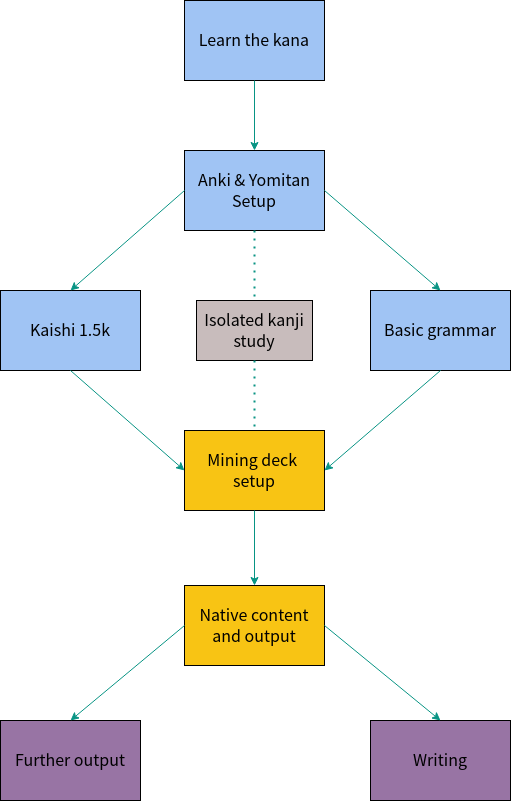
The most important (and longest) portion of it is by far “Native content and output”, because this is where you will do most of your learning past the beginner stages. Writing is separated for Japanese-specific reasons: Unless you are in Japan, you will most likely never need to write kanji in your life. Still, a lot of people choose to do it so it’s included here.
In order to best approach each step, I will detail the tools I would use, how I would use them, as well as common pitfalls to avoid. In general, you can find a large portion of the most useful tools in my Japanese Resources GitHub repository.
Learn kana
Before you do anything, I highly suggest you read Tae Kim from here to here. This will explain how the writing system in Japanese works. It is imperative you understand this before you jump into things fully.
I think to learn basic kana there are two really interesting and useful resources. If you are interested in using mnemonics to learn kana, I think the best I’ve seen was probably the articles by Tofugu, there is one on hiragana and one one katakana. This is a perfectly fine way to memorize kana, usually by making yourself a list or by writing them down if that interests you.
Personally, I find games more useful to learn and memorize kana. Learning them is boring for most people, so I find that a bit of gamification here works great. My favorite resource for this is Kuuube’s kana quiz (click on Kana Quiz to start it). You can also read his explanation on how the kana system work in Japanese.
Set up your tools
The immersion learning community has created a wealth of amazing tools to learn the language, some of which got so big that they are not being utilized in other language learning communities. There is a real boom happening that has started in 2020 during the pandemic and has mostly been ongoing. Discord servers that were once relatively modest have tens of thousands of people in them.
Tremendous work has been done to have top tier tools to learn Japanese with groundbreaking innovations happening practically every year since 2022. Still, the absolute essentials have mostly stayed the same, although they all got major updates over the years. These are the two pillars of the current Japanese immersion learning community: Anki and Yomitan.
Anki is a spaced-repetition system (SRS) that allows you to create decks of information to review (also called reps). These are like physical flashcards with a front and a back side. For a quick breakdown of what Anki is, see the background section of the Anki manual.
Yomitan is a pop-up dictionary for language learning that allows you to get definitions and readings for words on the fly in your browser. Originally only for Japanese, the tool got so popular it successfully into a variety of other languages.
These two tools are the backbone of the community, and although there are alternatives (most notably JPDB), they are still the recommended tools to learn the language. To see how to set up both of these tools, follow my setup guide. If you want a shorter guide with more spoondfeeding, follow Xelieu’s guide instead.
Basic vocabulary and grammar
Once you have Anki and Yomitan properly set up, it is time to start the first major step in learning the language: Basic vocabulary and grammar. The way we are going to learn vocabulary is through Anki.
There are a few pre-made Anki decks but the most popular in the community for the past year and a half has been Kaishi 1.5k. If you’re interested to see why Tyogin and myself created the deck, please see this. You can download the deck either on the GitHub releases page, or directly on Ankiweb.
For grammar, things are more complicated. I am currently working on a Japanese grammar textbook because I am unsatisfied with most other English resources on Japanese grammar. Still, a bit of basic grammar is very useful at the start so here are some suggestions.
If you’re a complete beginner, try Yokubi. It’s an adapted and rewritten version of an older guide. It’s meant to be approachable, so that’s good. If you’re more interested in something complete and technically correct, you can take a look at IMABI. It’s pretty rough though, because Seth (the author) is a linguist and uses precise grammatical terminology, and he expects you to be familiar with it, or at the very least to be willing to learn it.
Set up a mining deck
So you’ve finished Kaishi 1.5k and you’re done with Yokubi, huh? Good shit. Now the fun starts. First, read through this page on immersion. Then, set up a mining deck. I recommend my own note type, Lapis, but there are other really good ones out there. If you want something with more features, try Senren; if you want something more minimalistic, try crop-theft.
Make sure to follow the guides properly, because setting up a mining deck is not the easiest thing in the world. Either way, once you’re done doing that, choose a medium to immerse in. The most popular category are: anime, manga, (light) novels, visual novels, games, YouTube, VTubers, podcasts, and 3D (series, dramas and movies). My personal preference is visual novels for a variety of reasons. I am not the only one.
In general, I recommend immersing in at least one reading-based medium (e.g. novels) and at least one listening-based medium (e.g. anime). This is to avoid imbalance in your understanding which is especially common in the immersion learning community (which historically has been particularly skewed towards reading ability). Once you know what you want, then go through the specific immersion setups on my website, or take a look at the frameworks on the Japanese resources repository.
Native content and output
This is the part where you’re on your own. Well, not entirely. Once you have your specific immersion setups ready, you can either start with what you want to read or listen to, or you can use my Japanese media recommendations spreadsheet. Look for stuff that is rated “Very Easy” to “Easy”. If you want my personnal recs for first immersion material, here they are: for anime, start with Non Non Biyori (subtitles here); for manga, start with Tomo-chan wa Onnanoko!; for novels, start with Kuma Kuma Kuma Bear; for VNs, start with Tsuyuchiru Letter. These are standard recommendations and you can’t go wrong with them.
If you want a very simple list to follow in order to get better at Japanese, you can follow this recommendations list. Choose one VN among the three for each tier, and once you’re done reading (and mining) it, go down a tier. Some of these have adult content, so take this into consideration if that is a problem!
Either way, this is where I cannot help you anymore. The goal now is just to keep getting better as you read and listen through materials you enjoy. If you are interested, you can start learning how to write kanji. For an explanation on why it’s probably not a great idea to learn how to write at the start of your Japanese learning journey, read this. Of course, this is just advice, and you can decide to disregard if you wish. If you decide to learn how to write, go through this Anki deck.
Ideally, start outputting as soon as you feel ready. Often, it’s a good idea to start a bit before this. The more you can read and listen, the better you will be able to output eventually, but you still need to put in the work to be able to speak and write well. Keep at it, and you will get good faster than you can imagine. Don’t forget the magical words:
千里の道も一歩から。